A torsor (or principal homogeneous space) is, informally speaking, a mathematical structure quite similar to a group, but without a natural identity element. More formally, if is a group, a -torsor is a set on which acts simply and transitively, i.e., for every , there is a unique such that . Torsors are ubiquitous in mathematics, see for example this blog post by John Baez.
I noticed that one can define the notion of torsor without ever mentioning groups, and then recover the notion of a group from this, rather than vice-versa. I’ve never seen this formalized before, so I thought I’d take the time to write it down here. Please let me know if you’re aware of a reference! (Note added 9/18/23: Ben Steinberg points out that this is closely related to the notion of a heap — see below for additional details.)
I will coin a new term — proportion space — for the concept I’m about to describe. But we’ll see that a proportion space has an associated group which acts simply and transitively on , making into a -torsor, and conversely every torsor for a group is naturally a proportion space (with associated group isomorphic to ). So the concepts of torsor and proportion space are essentially equivalent, except for the fact that simply transitive group actions which differ by an automorphism of correspond to the same proportion structure on .
Proportion spaces
A proportion structure on a non-empty set is a pair of equivalence relations and on satisfying the following two axioms:
(PS1) if and only if .
(PS2) Given , there is a unique such that .
The intuition here is that if is a group, we can think of as the relation defined by iff , and of as the relation defined by iff . If is abelian, these relations will coincide, but in general they will be different; this is why we need to consider two different equivalence relations. Each of the two relations and determines the other, by (PS1), but the conditions for to be an equivalence relation are different from the conditions for to be an equivalence relation. Nevertheless, in a group we do have iff , which is (PS1).
A proportion space is a pair consisting of a set and a proportion structure on .
A pointed proportion space (PPS) is a proportion space together with a fixed “base point” .
Alternate formulation
It will be more convenient for us to make a choice and work with a single equivalence relation, so we write for in what follows. We think of as meaning“ is to as is to ”. In terms of the single relation , a proportion structure on a non-empty set is a relation on satisfying the following for all :
(PS1a) is an equivalence relation.
(PS1b) .
(PS1c) iff .
(PS1d) If and then .
(PS2) Given , there is a unique such that .
To see that (PS1a) through (PS1d) are equivalent to (PS1), note that (PS1) shows that is determined by , and via this correspondence the reflexivity of is (PS1b), symmetry of is (PS1c), and transitivity of is (PS1d).
(Note added 6/10/24: A blogger named The House Carpenter pointed out in that my original axioms for a proportion space were too weak; I had inadvertently omitted (PS1c) and (PS1d). The axioms (PS1a), (PS1b), and (PS2) are not sufficient to prove that the group associated to a proportion space is well-defined; see this post for an explicit counterexample. The House Carpenter also points out that axiom (PS1c) follows from (PS1a), (PS1b), (PS1d), and (PS2); for a proof see the notes at the end of this post.)
Examples
Before formally explaining the relation to groups and torsors, we give some illustrative examples (some of which I’ve borrowed from John Baez’s blog post referenced above):
Example 1: If is a group, then the relation iff in makes into a proportion space. And taking our base point to be the identity element makes into a pointed proportion space.
Example 2: An affine plane (i.e., a Euclidean plane without a distinguished origin) is naturally a proportion space, where iff the displacement vector from to has the same direction and magnitude as the displacement vector from to .
Example 3: The set of notes in the (12-tone, equal temperament) chromatic scale is naturally a proportion space, where iff the number of half-steps from up to the nearest is equal to the number of half-steps from up to the nearest .
Example 4: The set of dates in a perpetual (forward and backward) calendar is a proportion space. Here, we say that iff the number of days from to (thought of as a not-necessarily-positive integer) equals the number of days from to .
Example 5: If is a connected plane graph (i.e., a connected finite graph embedded in the plane without crossings), the set of spanning trees of admits a canonical proportion structure. See this post for details on how the proportion structure is defined.
In Examples 2-5, the notion of proportionality is in some sense the only ‘natural’ additional structure we have on the given set. In particular, there is no distinguished identity element and no natural notion of addition.
The Theorem
In order to state the main result of this post, we say that two torsor structures and on are equivalent if there is an isomorphism such that for all and .
Theorem: Let be a non-empty set. There are natural bijective correspondences between:
(a) Proportion structures on and equivalence classes of torsor structures on .
(b) Pointed proportion spaces and groups.
In particular, one could define a torsor to be a proportion space, and then subsequently define a group to be a pointed proportion space. (I will let the reader decide whether this is a pedagogically sound idea…)
Proof (Sketch): Given a group and a -torsor , we define a relation on by setting iff there exists such that and . It is straightforward to check that this relation satisfyies (PS1a)-(PS1d) and (PS2). For example, in order to show that is transitive, which is part of (PS1a), suppose and . Then there exists a unique such that and , and this same must then satisfy . It follows that . Similarly, to check (PS1d), suppose and . Then there exists such that and , as well as such that and . The axioms for a group action show that satisfies and , i.e., .
Note that if two torsor structures on are equivalent, they define the same proportion structure on . Indeed, given , there exists such that and iff there exists such that and iff there exists such that and .
Conversely, given a proportion space , we define an associated group as follows. As a set, define to be the set of equivalences classes of pairs with respect to . We denote by the equivalence class of . Define a binary operation on by setting , where is the unique element (guaranteed by (PS2)) such that . In other words, the group law is characterized by the rule , which is well-defined by (PS1d).
The identity element of is for any , which is well-defined by (PS1b), and the inverse of is given by , which is well-defined by (PS1c).
To check the associative law , we may assume using (PS2) that , and for some , and then the verification becomes straightforward.
We define an action of on by setting . To check the axiom for a group action, we may assume that , and for some , in which case the verification is again straightforward.
We leave it as an exercise for the reader to check that the two constructions just given are inverse to one another. This establishes (a).
For (b), suppose we’re given a group . Then is a -torsor (and hence a proportion space) via the action of on itself by left multiplication, and the identity element is a distinguished base point of . Conversely, given a proportion space and a base point , we can identify with the associated group by letting correspond to . We again leave it as an exercise to check that these constructions are inverse to one another.
A Note on Naturality
As discussed above, simply transitive group actions which differ by an automorphism of correspond to the same proportion structure on . This is a somewhat subtle point, so it’s worth taking a look at how this plays out in some of our examples.
In Example 2, the group associated to the affine plane can be identified (in many different ways!) with . There are, correspondingly, many different simply transitive group actions of on that correspond to the same proportion structure on . Specifically, for any non-zero real number , we can make act on via , and each of these actions corresponds to the same proportion space. Philosophically, assigning a magnitude to the displacement vector between and requires coordinatizing the plane , whereas the notion of proportionality is coordinate-free.
Interestingly, however, the action of itself on is canonical: it’s given by . It’s the identification of with that is non-canonical. (Note added 9/19/23: Thanks to Jordan Ellenberg for clarifying this point for me.)
Similar considerations hold in Examples 3 through 5. In Example 3, for instance, the circle of fifths corresponds to a different action of the group yielding the same proportion structure as either the “ascending half-note” or “descending half-note” action.
For the record, clarifying such “naturality” considerations was the reason I started thinking about proportion spaces in the first place. However, it seems that the ancient Greeks beat me to it:
Ancient Greek mathematicians calculated not with quantities and equations as we do today; instead, a proportionality expressed a relationship between geometric magnitudes. The ratio of two magnitudes was not a numerical value, as we think of it today; the ratio of two magnitudes was a primitive relationship between them.
Right after I published this post, my friend Ben Steinberg pointed out that the formalism described above is mathematically equivalent to the notion of a heap. More precisely, a heap is a set together with a ternary operation on that satisfies the following identities:
(H1) .
(H2) .
I didn’t check the details carefully, but I believe that heaps and proportion spaces are equivalent to one another via the correspondence , where is the unique element of such that .
I must say that (in my own completely unbiased opinion) I prefer the notion of proportion space, as I find it more intuitive. (See the comments below, however, for some reasons one might prefer the notion of heap.)
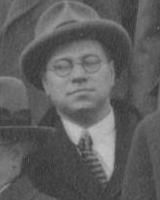
It seems that the notion of heap was introduced by Heinz Prüfer in the abelian case in 1924, and by Reinhold Baer in general in 1929. I imagine that Prüfer would have found the connection to spanning trees interesting!
Heinz Prüfer
Redundancy of axiom (PS1c)
As mentioned earlier in the post, axiom (PS1c) (the symmetry of ) actually follows from (PS1a), (PS1b), (PS1d), and (PS2). Here is a proof by The House Carpenter.
Suppose we’re given such that , i.e., . We want to show that , i.e., . By (PS2), there is a unique such that , i.e., . By the transitivity of , or equivalently (PS1d), it follows that , i.e., . But by the reflexivity of , or equivalently (PS1b), we also have . By (PS2), we must have . Together with the previously established relation , this implies , i.e., , as desired.
Ben Steinberg made some interesting comments about this post on Facebook, and he gave me permission to copy and paste them here.
1. Regarding the relation between proportion spaces and heaps, Ben writes, “Matt, that seems right. Your axioms seem to catch the heap axioms. The advantage of the heap axioms is that they are universally quantified and show that torsors are a type of universal algebra. Axioms that require binary relations and things to exist and be unique are logically more complex. But your approach does match well the physics approach to vectors as being unbased and where magnitude and direction only matter.”
2. He then adds, “The nice thing about the universal algebra view is it makes the definition of subheap and homomorphism clear. A fun exercise is the nonempty subheaps of a group are precisely the cosets of subgroups. From the fact that subheaps form a complete lattice it follows that any nonempty subset of a group is contained in a unique smallest coset. One can of course compute that directly….
One can use this to turn the cosets of a group into an inverse monoid by taking the product of two cosets to be the smallest coset containing them both. This is associative. If K/F is a finite Galois extension this coset inverse monoid is isomorphic to the inverse monoid of all F-isomorphisms of intermediate fields (where composition is defined where it makes sense). This is essentially a reformulation of the fundamental theorem of Galois theory.
The key point is every left coset is a right coset via and a nonempty subset A of G is a coset if . You can use for right cosets as the subgroup.”
Do you see a straightforward way to categorify the definition of a proportion space? This is an especially useful move with torsors in algebraic geometry and the notion of a heap seems more amenable to categorification. This might be one reason to prefer heaps although like you, I agree that the axioms of a proportion space are more intuitive.
Hi Asvin – No, I guess I don’t see a straightforward way to do that. You’re right that this seems easier with the definition of a heap, so score another +1 for heaps. This is related, I guess, to Ben Steinberg’s comment above: “The advantage of the heap axioms is that they are universally quantified and show that torsors are a type of universal algebra. Axioms that require… things to exist and be unique are logically more complex.”


![[(a,b)]](https://s0.wp.com/latex.php?latex=%5B%28a%2Cb%29%5D&bg=ffffff&fg=404040&s=0&c=20201002)

![[(a,b)] * [(c,d)] := [(e,d)]](https://s0.wp.com/latex.php?latex=%5B%28a%2Cb%29%5D+%2A+%5B%28c%2Cd%29%5D+%3A%3D+%5B%28e%2Cd%29%5D&bg=ffffff&fg=404040&s=0&c=20201002)
![[(a,b)] = [(e,c)]](https://s0.wp.com/latex.php?latex=%5B%28a%2Cb%29%5D+%3D+%5B%28e%2Cc%29%5D&bg=ffffff&fg=404040&s=0&c=20201002)
![[(a,b)] * [(b,c)] := [(a,c)]](https://s0.wp.com/latex.php?latex=%5B%28a%2Cb%29%5D+%2A+%5B%28b%2Cc%29%5D+%3A%3D+%5B%28a%2Cc%29%5D&bg=ffffff&fg=404040&s=0&c=20201002)
![[(a,a)]](https://s0.wp.com/latex.php?latex=%5B%28a%2Ca%29%5D&bg=ffffff&fg=404040&s=0&c=20201002)

![[(b,a)]](https://s0.wp.com/latex.php?latex=%5B%28b%2Ca%29%5D&bg=ffffff&fg=404040&s=0&c=20201002)

![g_1 = [(a,b)], g_2 = [(b,c)]](https://s0.wp.com/latex.php?latex=g_1+%3D+%5B%28a%2Cb%29%5D%2C+g_2+%3D+%5B%28b%2Cc%29%5D&bg=ffffff&fg=404040&s=0&c=20201002)
![g_3 = [(c,d)]](https://s0.wp.com/latex.php?latex=g_3+%3D+%5B%28c%2Cd%29%5D&bg=ffffff&fg=404040&s=0&c=20201002)
![[(a,b)] \cdot b := a](https://s0.wp.com/latex.php?latex=%5B%28a%2Cb%29%5D+%5Ccdot+b+%3A%3D+a&bg=ffffff&fg=404040&s=0&c=20201002)


![[(x,e)] \in G_X](https://s0.wp.com/latex.php?latex=%5B%28x%2Ce%29%5D+%5Cin+G_X&bg=ffffff&fg=404040&s=0&c=20201002)


![[(a,b)]\cdot b = a](https://s0.wp.com/latex.php?latex=%5B%28a%2Cb%29%5D%5Ccdot+b+%3D+a&bg=ffffff&fg=404040&s=0&c=20201002)




 Matt Baker's Math Blog
Ben Steinberg made some interesting comments about this post on Facebook, and he gave me permission to copy and paste them here.
1. Regarding the relation between proportion spaces and heaps, Ben writes, “Matt, that seems right. Your axioms seem to catch the heap axioms. The advantage of the heap axioms is that they are universally quantified and show that torsors are a type of universal algebra. Axioms that require binary relations and things to exist and be unique are logically more complex. But your approach does match well the physics approach to vectors as being unbased and where magnitude and direction only matter.”
2. He then adds, “The nice thing about the universal algebra view is it makes the definition of subheap and homomorphism clear. A fun exercise is the nonempty subheaps of a group are precisely the cosets of subgroups. From the fact that subheaps form a complete lattice it follows that any nonempty subset of a group is contained in a unique smallest coset. One can of course compute that directly….
One can use this to turn the cosets of a group into an inverse monoid by taking the product of two cosets to be the smallest coset containing them both. This is associative. If K/F is a finite Galois extension this coset inverse monoid is isomorphic to the inverse monoid of all F-isomorphisms of intermediate fields (where composition is defined where it makes sense). This is essentially a reformulation of the fundamental theorem of Galois theory.
The key point is every left coset is a right coset via and a nonempty subset A of G is a coset if
  . You can use
  for right cosets as the subgroup.”
Do you see a straightforward way to categorify the definition of a proportion space? This is an especially useful move with torsors in algebraic geometry and the notion of a heap seems more amenable to categorification. This might be one reason to prefer heaps although like you, I agree that the axioms of a proportion space are more intuitive.
Hi Asvin – No, I guess I don’t see a straightforward way to do that. You’re right that this seems easier with the definition of a heap, so score another +1 for heaps. This is related, I guess, to Ben Steinberg’s comment above: “The advantage of the heap axioms is that they are universally quantified and show that torsors are a type of universal algebra. Axioms that require… things to exist and be unique are logically more complex.”
John Baez points out that my definition of “proportion space” has elements in common with the definition of a possibly-empty group in his blog post https://golem.ph.utexas.edu/category/2020/08/the_group_with_no_elements.html
Pingback: A note on the correct definition of a proportion space | The House Carpenter
Pingback: Why can’t we add two temperatures?: Part #3 | The long tail