My coauthors June Huh, Mario Kummer, Oliver Lorscheid, and I just posted a paper called Lorentzian polynomials and matroids over triangular hyperfields, Part 2: Analytic aspects on the arXiv preprint server. This is the first paper of mine to contain a substantial result proved by AI, and also the first to contain a proof formally verified in Lean. So I thought I would take this opportunity to tell a bit of the backstory.
Although our paper is motivated by the general theory of Lorentzian polynomials and matroids with coefficients, which are a bit daunting to explain in a short post, the parts in which AI played a decisive role can be explained in a completely elementary way. I will first state some of our main results, as well as our main open conjecture, in terms of basic linear algebra. Then I will discuss how AI—primarily Chat GPT-5.5—was able to prove a theorem that had previously eluded us.
The  -inequalities
We assume 
Definition.
- We call an
real matrix
admissible if it is symmetric, has zero diagonal, and has strictly positive off-diagonal entries.
- We say that an admissible matrix
satisfies the
-inequalities if, for every quartet
with
, the maximum of the three products
is attained at least twice.
- Let
. We say that an admissible matrix
are the side lengths of a possibly degenerate Euclidean triangle.
In a precise sense, the 


The -inequalities and Lorentzian signature
It follows from a theorem of Brändén and Huh that an admissible matrix
A natural generalization—and strengthening—is to ask whether, for each 

One of our theorems says that such a constant does exist:
Theorem A. For
Let
be admissible, and suppose that
-inequalities. Then

Our proof takes a perhaps-unexpected detour through a connection with Euclidean embeddings of metric spaces.
Schoenberg theory
The following result is a variant of a classical theorem of Schoenberg:
Theorem (Schoenberg). Let
be points in some Euclidean space
, and let
Then the associated Cayley–Menger matrix
has at most one positive eigenvalue.

![\displaystyle A:=\begin{pmatrix}0&\mathbf{1}^{\top}\\[2pt]\mathbf{1}&B\end{pmatrix}](https://s0.wp.com/latex.php?latex=%5Cdisplaystyle+A%3A%3D%5Cbegin%7Bpmatrix%7D0%26%5Cmathbf%7B1%7D%5E%7B%5Ctop%7D%5C%5C%5B2pt%5D%5Cmathbf%7B1%7D%26B%5Cend%7Bpmatrix%7D&bg=ffffff&fg=404040&s=0&c=20201002)
(Although we will not need it here, an appropriately formulated converse is also true.)
Here is the connection with Theorem A. After rescaling 


Thus Theorem A reduces to the following result of Timothy Faver, Katelynn Kochalski, Mathav Kishore Murugan, Heidi Verheggen, Elizabeth Wesson, and Anthony Weston:
Theorem (FKMVWW). Let
, let
be an
-point metric space, and set
If
, then the snowflaked metric space
admits an isometric embedding into
.

Taking 


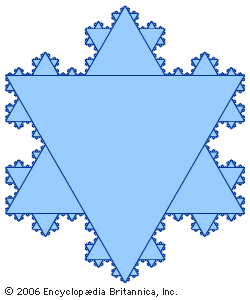
The word snowflaked is used because, in metric geometry, replacing a metric 

The bound is not optimal
For 


Define 


An explicit construction in our paper gives the following general upper bound for
Theorem B. For every
![\displaystyle q(n)\leq p(n):=\begin{cases}2\log_2\!\left(\dfrac{n}{n-2}\right),&\text{if }n\text{ is even},\\[7pt]\log_2\!\left(\dfrac{n+1}{n-3}\right),&\text{if }n\text{ is odd}.\end{cases}](https://s0.wp.com/latex.php?latex=%5Cdisplaystyle+q%28n%29%5Cleq+p%28n%29%3A%3D%5Cbegin%7Bcases%7D2%5Clog_2%5C%21%5Cleft%28%5Cdfrac%7Bn%7D%7Bn-2%7D%5Cright%29%2C%26%5Ctext%7Bif+%7Dn%5Ctext%7B+is+even%7D%2C%5C%5C%5B7pt%5D%5Clog_2%5C%21%5Cleft%28%5Cdfrac%7Bn%2B1%7D%7Bn-3%7D%5Cright%29%2C%26%5Ctext%7Bif+%7Dn%5Ctext%7B+is+odd%7D.%5Cend%7Bcases%7D&bg=ffffff&fg=404040&s=0&c=20201002)
The upper and lower bounds supplied by Theorems A and B agree up to absolute constant factors, and thus

We believe that the upper bound gives the correct answer:
Conjecture A. For every
.
There are two distinct reasons that the lower bound in Theorem A is not sharp:
- The exponent in the FKMVWW theorem is not optimal. For example, when
—which corresponds to
—we have
. But a theorem of Blumenthal shows that, for every four-point metric space
for all
. To the best of our knowledge, the optimal general exponent remains open for
.
- The reduction of Theorem A to the FKMVWW theorem discards some of the extra structure supplied by the
Evidence for the conjecture
As already mentioned, Conjecture A is true for
Theorem C.
.
Note that Theorem A gives only the weaker lower bound

Combining Theorem C with Theorem B gives:
Corollary.
.
As previously mentioned, the proof of Theorem A discards some extra structure implied by the
Definition. A metric space 

The name refers, of course, to the classical Ptolemy inequality in Euclidean geometry. Ptolemaic metric spaces are quite natural objects to study; for example, Schoenberg proved that a real normed vector space is Ptolemaic if and only if its norm comes from an inner product.
The normalization described earlier explains why Ptolemaic spaces arise naturally in our setting: the
Conjecture B. Let
and
. If
GPT-5.5 Pro produced a proof of Theorem C (which is equivalent to Conjecture B in the special case
Brief outline of the proof
The key new idea in ChatGPT’s proof of Theorem C is a clever reduction from an arbitrary four-point Ptolemaic metric to a handful of boundary cases. Blumenthal’s theorem already covers 


Checking and refining the proof
There were parts of the original proof that I did not understand, so I asked GPT-5.5 Pro and Claude Opus a number of questions. Those exchanges eventually produced a significantly simpler version of the argument.
The proof was still fairly complicated and difficult to check, so I enlisted David Renshaw’s help in formalizing it in Lean. David used Claude Code together with Lean to autoformalize the proof. Apart from writing the theorem statement in Lean and supplying Claude Code with the natural-language proof from our draft manuscript, neither David nor I provided further mathematical input. After the harness ran overnight, the resulting Lean development checked successfully. The Lean formalization can be found here.
As a bonus, Claude Code found some simplifications to the case analysis during formalization. We therefore ended up with a proof that is not only formally verified, but also easier for a human to read than the original. (Perhaps this gives a glimmer of hope to those currently despairing about the future of mathematics; there are manifold ways in which AI can help improve human understanding of mathematics—presumably the main goal of whatever it is that we mathematicians claim to do! Of course, there are clearly huge downsides as well, but that is a topic for another post…)
Looking ahead, I view Conjecture B—or, equivalently, Conjecture A—as an interesting challenge for humans, future AI systems, or both.


Pingback: Some late-night thoughts on AI and the future of research in mathematics | Matt Baker's Math Blog