The 2018 Georgia Algebraic Geometry Symposium is a wrap! This was the first time that the annual conference was held at Georgia Tech, and I thought it went very well. Each of the eight talks seems to have been well-received, and some spectacular new results were announced. Here’s a quick summary of (what I remember about) the talks: Continue reading
The Circuit-Cocircuit Reversal System and Torsor Structures on Spanning Trees
The Jacobian of a finite graph 


In the present post, I’d like to discuss a different family of simply transitive actions of
One of the main new ideas in [BBY] (as we will henceforth refer to our paper) is to use the torsor 

The Geometry of Break Divisors
I’d like to continue this discussion of break divisors on graphs & tropical curves by describing an interesting connection to algebraic geometry. In this post, I’ll explain a beautiful connection to the theory of compactified Jacobians discovered by Tif Shen, a recent Ph.D. student of Sam Payne at Yale. Continue reading
The Combinatorics of Break Divisors
I recently gave three lectures at Yale University for the Hahn Lectures in Mathematics. The unifying theme of my talks was the notion of break divisor, a fascinating combinatorial concept related to the Riemann-Roch theorem for graphs. Some applications of break divisors to algebraic geometry will be discussed in a follow-up post.
Break divisors on graphs
Let 



A break divisor on 


Whitney Encounters of the Second Kind
I’m speaking tomorrow in the AMS Current Events Bulletin about the work of Adiprasito, Huh, and Katz on the Rota-Welsh conjecture and Hodge theory for matroids. See this previous post for an introduction to their work. [Note added 9/21/17: My write-up for the Current Events Bulletin can be found here.]
Here’s an excerpt from the last section of my slides which I may or may not have time to discuss in tomorrow’s talk. It concerns this recent paper of June Huh and Botong Wang. (Note added: As anticipated I did not have time to cover this material! Here are the slides themselves: ceb_talk)
p-adic Numbers and Dissections of Squares into Triangles
My thesis advisor Robert Coleman passed away two years ago today (see this remembrance on my blog). One of the things I learned from Robert is that p-adic numbers have many unexpected applications (see, for example, this blog post). Today I want to share one of my favorite surprising applications of p-adic numbers, to a simple problem in Euclidean geometry. Continue reading
Matroids over Hyperfields, Part II
In Part I of this post, we defined hyperrings and hyperfields, gave some key examples, and introduced matroids over (doubly distributive) hyperfields in terms of Grassman-Plücker functions. If 


Probability, Primes, and Pi
What is the probability that two randomly chosen integers have no prime factors in common? In honor of Pi Day, I’d like to explain the surprising answer: 
The hero of this story is Leonhard Euler, who worked out this astonishing connection between prime numbers and 

Matroids over Hyperfields, Part I
In this post and its sequel, I’d like to explain a new perspective on matroid theory which was introduced in this recent preprint which I wrote with Nathan Bowler. The main observation is that by working with algebraic structures called hyperfields, in which addition is allowed to be multi-valued, linear subspaces, matroids, valuated matroids, and oriented matroids become special cases of a single general concept. In the process of explaining this observation, I also hope to advertise how natural hyperfields are, for example in the context of tropical geometry.
Hyperstructures
The notion of an algebraic structure in which addition is allowed to be multi-valued goes back to Frédéric Marty, who introduced hypergroups in 1934. Later on, in the mid-1950’s, Marc Krasner developed the theory of hyperrings and hyperfields in the context of approximating non-Archimedean fields, and in the 1990’s Murray Marshall explored connections to the theory of real spectra and spaces of orderings. For the most part, however, the theory of hyperstructures was largely ignored by the mathematical community at large until Connes and Consani started advocating its potential utility in connection with 
Hodge Theory in Combinatorics

From L to R: Karim Adiprasito, June Huh, Eric Katz
In January 2016, my colleague Josephine Yu and I are organizing a workshop called Hodge Theory in Combinatorics. The goal of the workshop is to present the recent proof of a 50-year-old conjecture of Rota by Karim Adiprasito, June Huh, and Eric Katz. In this post, I want to explain what the conjecture says and give a brief outline of its marvelous proof. I will follow rather closely this paper by Adiprasito-Huh-Katz (henceforth referred to as [AHK]) as well as these slides from a talk by June Huh. Continue reading
The Jordan Canonical Form
In my current position as Director of Undergraduate Studies for the Georgia Tech School of Mathematics, I’ve been heavily involved with revamping our linear algebra curriculum. So I’ve spent a lot of time lately reading through various linear algebra books. The goal of this post is to give a self-contained proof of the existence and uniqueness of the Jordan Canonical Form which is somewhat different from the ‘usual’ proofs one finds in textbooks. I’m not claiming any novelty — I’m sure this approach has been discovered before — but I don’t know a good reference so I thought I’d record the details here.
The proof I give here does not use properties of polynomials (e.g. the Chinese Remainder Theorem), nor does it rely on the classification of finitely generated modules over a PID, so it might be of some pedagogical interest. The proof I give for the Generalized Eigenvector Decomposition is based on an auxiliary result — the Fitting Decomposition — which in my opinion ought to be better known. The proof I give of the structure theorem for nilpotent operators comes from these lecture notes of Curt McMullen (Theorem 5.19). It is particularly concise compared to some other arguments I’ve seen. Continue reading
A Celebration of Independence
Yesterday marked the second anniversary of my blog, and today is the 239th birthday of the U.S. In celebration of Independence Day, I want to explain what matroids are. Matroids were invented by Hassler Whitney (and independently by Takeo Nakasawa) to abstract the notion of linear independence from vector spaces to a much more general setting that includes acyclicity in graphs. Other pioneering early work on matroids was done by Garrett Birkhoff and Saunders MacLane. Matroid theory is a rich subject about which we will only scratch the surface here. In particular, there are many different (“cryptomorphic“) ways to present the matroid axioms which all turn out to be (non-obviously) equivalent to one another. We will focus on just a couple of ways of looking at matroids, emphasizing their connections to tropical geometry. Continue reading
Number Theory and Cryptography: A Distance Learning Course for High School Students
The following post was originally published on the AMS Blog “On Teaching and Learning Mathematics”. I have reproduced it here with the permission of the AMS.
Last year, I began offering an online Number Theory and Cryptography course for gifted high school students through Georgia Tech. Fourteen high school seniors from metro Atlanta took the course in Fall 2014, and overall I would say it was a big success. We will be offering the course again in Fall 2015 and are expecting roughly double the number of students. After describing the structure of the course, I will relate some of my experiences and describe some of the things I learned along the way. I hope this article stimulates others to think outside the box about using technology in education without necessarily following the standard “MOOC” model.
Continue reading
John Nash and the theory of games
John Forbes Nash and his wife Alicia  were tragically killed in a car crash on May 23, having just returned from a ceremony in Norway where John Nash received the prestigious Abel Prize in Mathematics (which, along with the Fields Medal, is the closest thing mathematics has to a Nobel Prize). Nash’s long struggle with mental illness, as well as his miraculous recovery, are depicted vividly in Sylvia Nasar’s book “A Beautiful Mind” and the Oscar-winning film which it inspired. In this post, I want to give a brief account of Nash’s work in game theory, for which he won the 1994 Nobel Prize in Economics. Before doing that, I should mention, however, that while this is undoubtedly Nash’s most influential work, he did many other things which from a purely mathematical point of view are much more technically difficult. Nash’s Abel Prize, for example (which he shared with Louis Nirenberg), was for his work in non-linear partial differential equations and its applications to geometric analysis, which most mathematicians consider to be Nash’s deepest contribution to mathematics. You can read about that work here. Continue reading
The Sign of the Quadratic Gauss Sum and Quadratic Reciprocity
Today marks the birthday of Karl Friedrich Gauss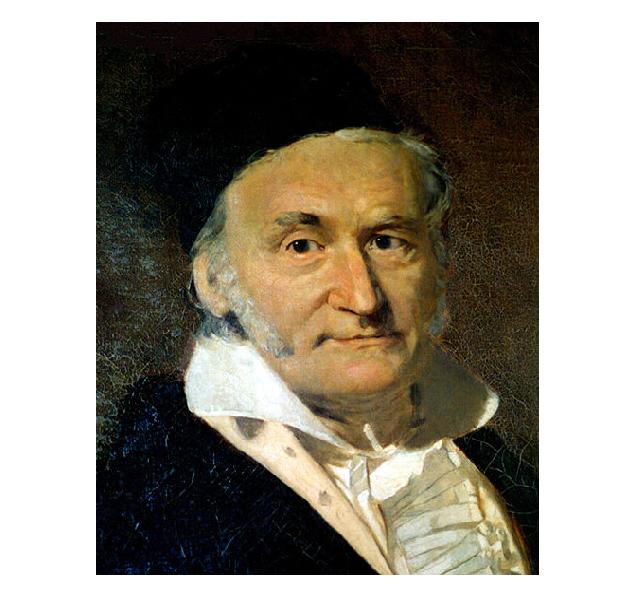 , the “Prince of Mathematicians”, who was born on April 30, 1777. In honor of Gauss’s 238th birthday, I thought I would blog about one of Gauss’s favorite theorems — the Law of Quadratic Reciprocity — and its relation to the sign of the quadratic Gauss sum, which we will determine using the Discrete Fourier Transform. Our exposition mostly follows this paper by Ram Murty. Regarding the sign of the quadratic Gauss sum, Gauss conjectured the correct answer in his diary in May 1801, but it took more than four years until he was able to find a proof in August 1805. Gauss wrote to his friend W. Olbers that seldom had a week passed for four years that he had not tried in vain to prove his conjecture. Then:
Finally, two days ago, I succeeded – not on account of my hard efforts, but by the grace of the Lord. Like a sudden flash of lightning, the riddle was solved. I am unable to say what was the conducting thread that connected what I previously knew with what made my success possible.
 Matt Baker's Math Blog